
Shifting Digital Landscapes
Changes in technology and permission to disappear

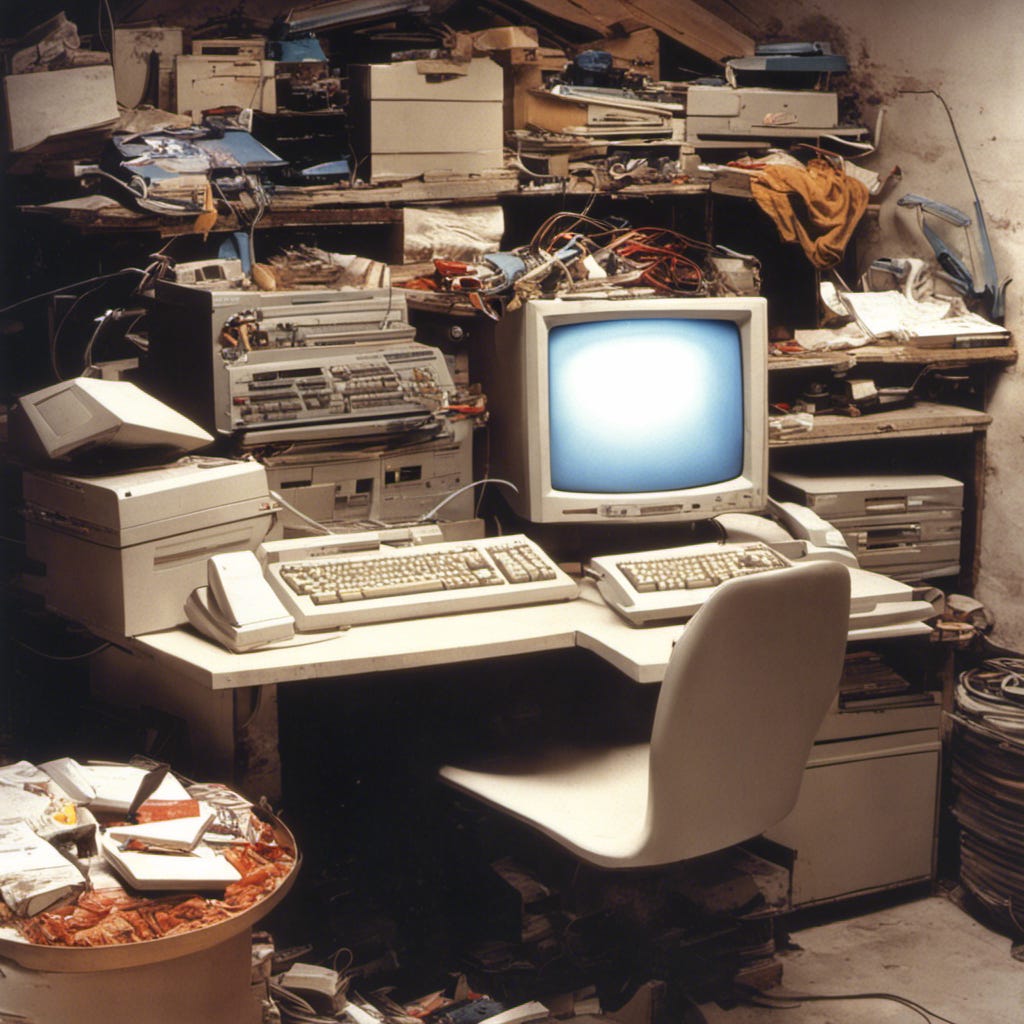
I was huddled near a large desktop computer at my friend Mariano’s house. It was 1997. Mariano was “gifted” in computer programming—owing in large part to his parents’ investment in an Amiga computer, the envy of his friends—and was headed off to M.I.T. to study robotics. But first, my friend Sam and I had convinced Mariano to help us set up a website for our fledgling garage band. We knew the website would have to use something called html and we had purchased a dot com, but we didn’t exactly know how to connect the dot com with the html. Although it’s true a lot of people still struggle to figure this out, in those days this kind of knowledge was absolutely esoteric; there was no Google and most adults barely even knew what the internet even was. But Sam was determined to make this work. And so Mariano was our oracle and guide, typing away on the keyboard talking about ISP and DNS while we told him about our music.
Five years later Sam and I were on stages playing for thousands of people during a tour for the release of our debut major-label album for MCA. My adventures—meeting Elton John and Christina Aguilera, opening for bands like Muse and The Counting Crows, and growing up as a young adult on the road just generally having a blast with my best buds—I owe in large part to Sam’s ability to anticipate big shifts in media and culture, particularly where things were headed online.
Sam first advocated for a website in the first place. Then, Sam suggested that we create a section on our website that prefigured the blog. The “online journal” as we called it was a way to keep maintain a regular connection with our listeners through sharing stories.
Before our record came out, we put the entire thing online on our website in high quality mp3 format. The record label didn’t really know what to do about this. At the time, nobody really knew what to think about the relationship between the internet and music disemenation. We were and are, after all, between the ages of Mark Zuckerberg and Elon Musk. Like those two evil goons and lot of other people in the late 90’s and early 2000’s we were experimenting with the internet to see what it could do, to see what it could be (incidentally, Zuck would create Facebook at Cambridge just a few blocks away from our friend Mariano with the Amiga). We learned just enough html to make things work and at the time that was enough.
In the first years of the internet few bands even had websites. Having one was a stamp of professionalism (still is). And for young people looking to spend time online, websites provided spaces to just kind of hang out. Our site had message boards too, where a community of fans sprung up and had mostly respectful and productive discussions. The categories were amusingly simple:
The Band (General Discussion)
Religion/Politics/Philosophy
Music (General)
I’ve been fortunate to have people like Sam and Mariano in my life. My own expertise, however, has never been technological, technocratic or even entrepreneurial necessarily. That is to say, what I enjoy the most about being an artist is not keeping up with the latest changes in PHP code or media consumption or the latest version of the Instagram algorithm but rather expressing myself through whatever tools are most readily available. When I was a child that meant a pencil. Later, a guitar and computer. In college I discovered oil painting.
Today we live in an environment where smartphones may be more readily available than pencils. We’re still figuring out what that means. This oft-quoted Marshall McLuhan passage remains relevant:
The medium is the message. This is merely to say that the personal and social consequences of any medium - that is, of any extension of ourselves - result from the new scale that is introduced into our affairs by each extension of ourselves, or by any new technology.
The scale, social consequence and shifts the internet brings regularly and quickly are profound. This is not the slow adoption of television. I recognize that for many, these social tools are their pencils and their paintbrushes. What artists do is take what is around and figure out how to be creative with it. But today, the lines between creation and dissemination are so blurry and so confusing for both creator and consumer alike that I worry there is little time for reflection or for deep presence. We are essentially performing our roles as artists for unknowable audiences online while we are attempting to make art. All the while, the medium (and thus the message) shifts beneath our feet constantly as algorithms render our canvases unstable, warping and wobbling as we go. Consider changes even in the span of the last few months:
writers who kept up with their audiences on Twitter have found that platform nearly destroyed and renamed.
X (formerly Twitter) throttled links to Patreon (intentionally made them take longer to load) in order to discourage folks navigating to the site and supporting artists.
Instagram, a platform created to share photographs in real time, has changed its algorithm to privilege only short videos that look like TikTok videos and make use of “trending audio”.
For creators these shifts can be techtonic, not to mention disruptive, cruel and sudden. I often think of my own experience in the (old) music industry. The writing was on the wall for years as Napster and CD burning slowly rolled in and word of layoffs at labels spread. I prepared myself, however unconsciously, by exploring new kinds of music-making and finding new ways to disseminate my music and art.
* * *
When my rock band’s advance money from the label began to run out my friend Sam again had a suggestion that now seems prescient—we simply ask our fans for money. We created a “tip the band” link on our website. At the time, this was almost a faux pas, simply asking fans for money. The nerve! Our tour manager wrote me a sternly worded email about how desperate it came across and how inappropriate it was. There was no Patreon or Gofundme or the like and so there was no precedent. But for better or worse, this move correctly anticipated that as the old institutions that supported artists and musicians began to decline and as the distance between audience and maker collapsed, people would become more open to the idea of direct support for creative people. Now, in an era of continuous, reckless digital disruption, there are no slow-motion waves.
The pressures to perform and to regularly share “content” are enormous. Sharing is existence online, and when you stop sharing you essentially stop existing in those spaces. If you’re not in the endless scroll, you’re just not in the room. But I want to advocate for a different kind of existence, one where long periods of rest and some reclusiveness are accepted. In an environment moderated by the twisted metrics of views and likes, disappearing to make our art can feel dangerous and forbidden. But that is precicely what we need to do in order to stay engaged with our craft, to avoid burnout and to have the space to reflect.
One thing that drew me to music and songwriting initially was the clearly demarcated boundaries between writing, studio time and performance. Writing a record meant privacy—time to experiment without a judging audience. I would lock myself in hotel bathrooms or hide in the basement, giving myself time to explore ideas that might lead to nowhere. Then I’d bring these unfinished ideas to the band, sometimes singing jibberish. Once we had some songs that were sounding good we could head into the studio. By the time we took the stage, the songs were more then ready—they were ready to shine brightly for a large public audience. Today, the boundaries between creative time and performing for a public audience have mostly disappeared online. For visual artists too, being in the studio once meant being away from the judging eyes of the public until the exhibition opened. Now, we are all on call, all the time.
Recently, I came across a post from a friend who is a social media strategist that suggested that all content posted to Instagram should be written or performed in such a way that it could be understood by a five-year-old. This gave me pause because. I know it is true—the majority of Instagram content was designed in such a way that it could be understood by my son who is four and a half (he’s six months advanced ha!).
This isn’t to shame anyone who has established and built a large public audience on social media. Like my friends Sam and Mariano on the Amiga, today we are all still just figuring it out as we go, seeing what the tools can do. Often social media companies themselves cannot anticipate how users will behave. And many artists have developed practices that deliberately blur the lines between performance and product in ways that are wonderfully subversive and creative. But I don’t envy anyone attempting to build an audience now from the ground up as the ground itself is constantly shifting beneath our feet.
How can we make things more stable for creators? How can we advocate for greater ownership of our tools and our time? These are the kinds of questions I will explore in my writing here, among other topics. And this is is giving myself permission to occasionally to make things in secret. To stop sharing. To be weird and make stuff with absolutely no utility or audience and have it “count”—if only for myself.